
Trailer sway and hitch setup: weight, tongue weight and weight-distribution basics
Sway is almost always a loading and setup problem. Correct tongue weight, a properly adjusted hitch, matched tires and sensible speed prevent most of it, which matters on windy southern Alberta highways.
Recommended tools & parts for this job

Hitch & towing
Tongue weight scale
Confirms tongue weight is in the right range for safe, stable travel.
Check price on Amazon.ca
Hitch & towing
Weight-distribution hitch with sway control
Restores steering weight and reduces sway on heavier travel trailers.
Check price on Amazon.ca
Tires & TPMS
Click-type torque wrench
Lug nuts must be torqued to spec, and re-checked after a wheel is removed.
Check price on Amazon.ca
Hitch & towing
Coupler / hitch lock
Basic theft deterrent while parked or in storage.
Check price on Amazon.ca
Leveling & stabilizing
Heavy-duty wheel chocks
Always chock before unhitching or working under the RV.
Check price on Amazon.ca
Tires & TPMS
Dial tire pressure gauge (high-pressure range)
RV tires often run at higher pressures than car gauges read well.
Check price on Amazon.caAs an Amazon Associate I earn from qualifying purchases. Always confirm part numbers and sizes against your RV or appliance model before ordering. See all recommended RV tools & parts →
Know your weight ratings
Before setting up a hitch, understand the numbers on your tow vehicle and trailer labels (door jamb, trailer placard and owner's manuals):
| Term | Meaning |
|---|---|
| GVWR | Gross Vehicle Weight Rating: the maximum loaded weight of a single vehicle (truck or trailer) |
| GCWR | Gross Combined Weight Rating: the maximum weight of truck plus trailer plus everything in both |
| GAWR | Gross Axle Weight Rating: the maximum load on each axle |
| Payload | What the truck can carry, including passengers, cargo and the trailer's tongue or pin weight |
| Hitch rating | The maximum trailer weight and tongue weight the hitch receiver and ball mount can handle (with and without weight distribution) |
| Maximum trailer weight rating | The manufacturer's maximum trailer weight, which assumes specific equipment and loading |
The lowest limit wins. Many people run out of payload before the maximum trailer weight rating, because tongue weight, passengers and gear add up quickly. The only way to know your real weights is to weigh the loaded combination at a certified scale.
Safety: Exceeding ratings affects braking, steering and stability, and may affect insurance. Alberta publishes a recreational vehicle trailer guide covering weights, brakes and equipment. Read it, and see Alberta RV rules basics: licensing, trailer brakes, weights and equipment.
Tongue weight: the key to stability
Tongue weight is the downward force the trailer coupler puts on the hitch ball. For conventional travel trailers, a commonly recommended range is roughly 10 to 15 percent of the loaded trailer weight. Fifth wheels carry a larger share on the pin. Check your trailer and hitch manufacturers' recommendations.
- Too little tongue weight is a leading cause of sway. The trailer's weight sits too far back.
- Too much overloads the truck's rear axle and lightens the front, reducing steering and braking.
Measure it with a tongue weight scale or at a certified scale using the method the scale operator recommends.
Loading the trailer
- Heavy items low and over or slightly ahead of the axles.
- Balance side to side.
- Secure everything so it can't shift.
- Don't put heavy gear on the rear bumper (generators, bikes on a bumper rack) without considering the effect on tongue weight and bumper strength.
- Water is heavy: roughly 1 kg per litre. A full fresh tank can shift tongue weight significantly depending on where the tank sits. Many people travel with fresh water at a low level and fill near camp, where practical.
Weight-distribution hitches
A weight-distribution (WD) hitch uses spring bars to transfer some tongue weight forward to the truck's front axle and back to the trailer's axles. That restores steering and braking feel and levels the rig. Many include sway control (friction or cam-style). Whether you need one depends on the truck, trailer and hitch ratings. Many receivers require WD above a certain tongue weight.
General setup process
Every WD hitch has its own procedure, so follow its manual exactly. The usual steps:
- Park the empty truck on level ground and measure the front and rear wheel-well heights (centre of the hub to the fender lip).
- Load the truck and trailer as you'd travel.
- Set the hitch ball height so the trailer sits level (or as the manufacturer specifies) when hitched.
- Hitch up without spring bars and measure again. The front of the truck rises.
- Install the spring bars and adjust tension (chain links or head tilt) until the front fender height returns toward the unloaded measurement, by the amount the hitch manual specifies.
- Torque all bolts to the hitch manufacturer's specs with a torque wrench.
- Test drive and re-check.
Don't over-tension. Removing too much weight from the rear axle can reduce rear traction.
Other causes of sway
- Under-inflated or mismatched tires on the truck or trailer. See RV tire care: how to prevent blowouts with correct pressure, load and age checks.
- Excess speed. Sway tendency increases with speed.
- Crosswinds and passing transport trucks. Southern Alberta highways, especially near the foothills and east of the mountains, are known for strong gusty winds.
- Worn trailer suspension or loose hitch hardware.
- A soft or overloaded truck rear suspension.
What to do if sway starts
- Stay calm. Don't steer sharply. Hold the steering wheel steady and straight.
- Ease off the accelerator. Don't slam on the truck's brakes.
- If you have a controller, apply the trailer brakes alone with the manual slider, gently. This helps pull the trailer straight behind you.
- Once stable, slow down, pull over safely, and work out why it happened before continuing.
Safety chains and coupler
- Cross safety chains under the coupler so they can cradle it if it detaches. Leave enough slack to turn without dragging.
- Make sure the coupler latch is locked and pinned. Visually check that the ball is fully seated.
- Connect the breakaway cable separately from the chains. See Travel trailer brakes not working: electric brakes, controller and breakaway checks.
- Use a coupler lock when parked.
Fifth-wheel hitch checks
- Confirm the jaws are locked around the kingpin with a visual check and a pull test (with trailer brakes applied).
- Check the hitch-to-trailer height so the trailer is level, and confirm cab clearance in tight turns (short-bed trucks may need a slider hitch).
- Lubricate the hitch plate as recommended.
When to call a pro
Choosing a hitch for a heavy trailer, receiver or frame damage, installing a fifth-wheel or gooseneck hitch in a truck bed, or ongoing sway after you've corrected loading, tires and hitch adjustment.
How-to videos

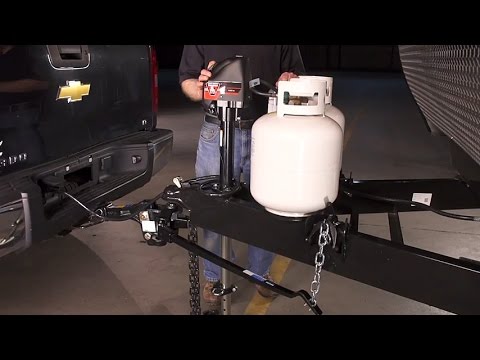
Videos are made by third-party creators and load from youtube-nocookie.com only when you press play. Models differ, so always follow your own manuals and the safety notes on this page.
Disclaimer: This guide is general information based on common RV designs. Models differ, so check your owner's manual and appliance manuals. Propane, 120V electrical and brake systems can cause serious injury if handled incorrectly. If you are unsure, stop and book a certified RV technician.