
Wiring RV solar panels in series, parallel or series-parallel
Series adds voltage, parallel adds current, and series-parallel does both. MPPT controllers let you use higher-voltage series strings with thinner wire. In Alberta's cold, always check the string's cold-weather open-circuit voltage against the controller's limit.
Recommended tools & parts for this job

Solar
MPPT solar charge controller
Converts higher panel voltage into charging current. The best choice for series strings and cold, bright days.
Check price on Amazon.caSolar
PWM solar charge controller
Simple and inexpensive for small systems with panels wired in parallel.
Check price on Amazon.ca
Solar
Solar combiner box
Combines parallel strings with fuses or breakers per string.
Check price on Amazon.ca
Solar
MC4 Y-branch connectors
Parallel two panels without a combiner on small systems. Mind the fuse rules.
Check price on Amazon.ca
Solar
Solar extension cable (MC4 ends)
UV-rated PV wire from panels to the roof entry.
Check price on Amazon.caSolar
MC4 connector kit and spanner
Connects and disconnects solar panel wiring safely.
Check price on Amazon.ca
Electrical & testing
Digital multimeter (auto-ranging, with DC amps)
The single most useful RV diagnostic tool: checks battery voltage, fuses, switches, continuity and 120V outlets.
Check price on Amazon.caAs an Amazon Associate I earn from qualifying purchases. Always confirm part numbers and sizes against your RV or appliance model before ordering. See all recommended RV tools & parts →
The two numbers on every panel
Every solar panel label lists several ratings. The ones that matter most for wiring are:
- Vmp and Imp: voltage and current at maximum power, under standard test conditions.
- Voc: open-circuit voltage, the highest voltage the panel produces when it's not connected to a load.
- Isc: short-circuit current, the highest current it produces.
- Maximum series fuse rating: the largest fuse allowed to protect the panel.
- Temperature coefficient of Voc: how much the voltage rises as the panel gets colder (as a % per °C).
The examples below use a made-up panel rated 20 V / 5 A at maximum power. Use your own panel's numbers.
Series wiring: voltages add
Connect the positive (+) of one panel to the negative (−) of the next. Voltage adds and current stays the same.
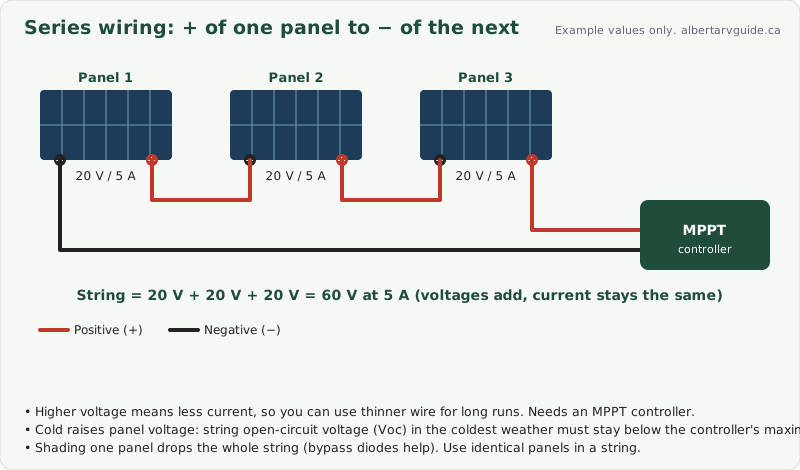
Three panels in series: 20 + 20 + 20 = 60 V at 5 A.
- Pros: Lower current means less voltage drop, so you can use thinner wire on long runs from roof to controller. Higher voltage also lets an MPPT controller start charging earlier in the morning and in weak light.
- Cons: Shade or snow on one panel reduces output of the whole string (bypass diodes in the panel help). Needs an MPPT controller. Cold-weather voltage must stay under the controller's limit.
Parallel wiring: currents add
Connect all positives together and all negatives together. Current adds and voltage stays the same.
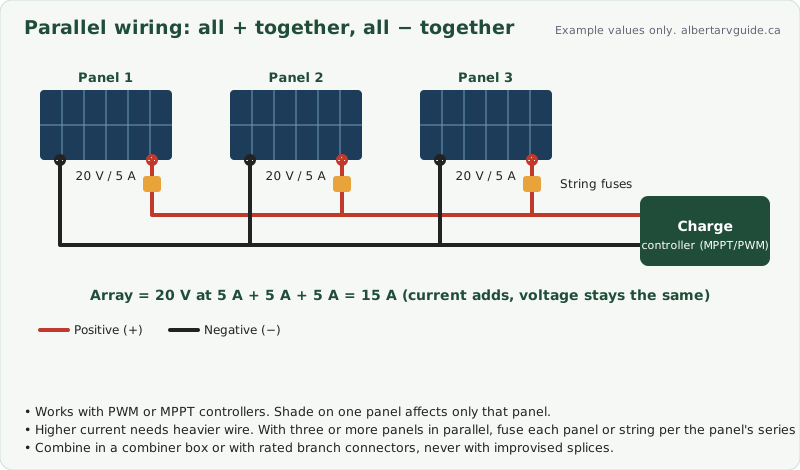
Three panels in parallel: 20 V at 5 + 5 + 5 = 15 A.
- Pros: Shade on one panel only affects that panel. Works with PWM controllers when panels are 12V-nominal.
- Cons: Higher current needs heavier wire. With three or more panels or strings in parallel, each one generally needs its own fuse, because a fault in one could receive current from all the others. Check the panel's maximum series fuse rating and the controller manual.
Series-parallel: the best of both
Wire panels into identical series strings, then connect the strings in parallel.

Two strings of two panels: each string 40 V at 5 A; combined 40 V at 10 A.
Every string must have the same number and type of panels. Mixing panels or string lengths wastes power and can confuse the controller.
MPPT vs PWM, and what it means for your wiring
- PWM controllers connect the panels more or less directly to the battery, so panel voltage is pulled down to battery voltage. Any panel voltage above what the battery needs is wasted. Use 12V-nominal panels in parallel with a 12V battery.
- MPPT controllers convert higher panel voltage into more charging current. They accept series strings and generally harvest more energy, especially when panels are cold. They cost more.
The Alberta cold-voltage check
Panel voltage rises as temperature drops. On a clear, cold Alberta morning, a series string can exceed the controller's maximum input voltage and damage it. Always do this check:
- Find the panel's Voc and temperature coefficient of Voc on the datasheet. For example, 22.5 V and −0.30 %/°C.
- Pick the coldest temperature the panels might see. Readings of −30 °C or colder happen in Alberta, and if you store or camp in winter, plan for them.
- Temperature difference from the 25 °C test condition: 25 − (−30) = 55 °C.
- Voltage increase: 55 × 0.30% = 16.5%. Cold Voc ≈ 22.5 × 1.165 ≈ 26.2 V per panel.
- Multiply by panels per string. 3 in series ≈ 78.6 V (fine for a 100 V controller). 4 in series ≈ 104.8 V, which exceeds a 100 V controller.
These are example numbers. Use your panel's datasheet and your controller's maximum PV input voltage. Some controller makers publish string-sizing calculators that do this for you.
Wire sizing and voltage drop
Wire must handle the current safely (ampacity), and long runs should keep voltage drop low.
- Voltage drop (V) ≈ 2 × one-way length × current × wire resistance per unit length. The "2" accounts for the positive and negative conductors.
- A common target for charging circuits is about 3% or less of system voltage.
- Size PV wire from the array's short-circuit current with a safety factor. Multiplying Isc by 1.25 is a widely used rule. Then check it against the fuse rating and voltage drop.
- Size the controller-to-battery cable for the controller's maximum output current, and keep that run short.
Wire manufacturers and controller makers publish ampacity and voltage-drop tables. Use them, and remember that wire inside hot roofs or bundled with other cables carries less current safely.
Quick comparison
| Series | Parallel | Series-parallel | |
|---|---|---|---|
| Voltage | Adds | Same as one panel | Adds within a string |
| Current | Same as one panel | Adds | Adds between strings |
| Controller | MPPT | PWM or MPPT | MPPT |
| Shading impact | Whole string | One panel | One string |
| Wire size | Smallest | Largest | Medium |
| Fusing | Usually one fuse/breaker | Fuse each panel when 3+ in parallel | Fuse each string when 3+ strings |
When to call a pro
If you're unsure about fusing, cold-weather voltage, or combining different panels, get advice from a qualified solar or RV electrical technician before you buy parts.
Related guides
How-to videos


Videos are made by third-party creators and load from youtube-nocookie.com only when you press play. Models differ, so always follow your own manuals and the safety notes on this page.
Disclaimer: This guide is general information based on common RV designs. Models differ, so check your owner's manual and appliance manuals. Propane, 120V electrical and brake systems can cause serious injury if handled incorrectly. If you are unsure, stop and book a certified RV technician.